
Artificial Intelligence (AI) has become one of the most powerful forces in gaming evolution. Developers now use AI to create smarter non-player characters (NPCs) that react realistically to player actions, making gameplay more dynamic and unpredictable.
AI is also used in procedural content generation, where entire worlds, missions, and environments are created automatically. This reduces development time while increasing creativity. In modern systems, AI even adapts difficulty levels based on player skill, ensuring a balanced experience for beginners and professionals.
Another growing trend is AI-generated storytelling, where game narratives change based on player decisions. This creates a personalized gaming journey that feels unique every time.
Cloud Gaming and Instant Access Revolution
Cloud gaming is changing how people access and play games. Instead of relying on powerful hardware, players can now stream games directly from remote servers. This means even low-end devices can run high-end AAA games smoothly.
Platforms like Xbox Cloud Gaming and NVIDIA GeForce NOW are leading this transformation. The biggest advantage is instant access—no downloads, no installations, just play.
However, cloud gaming depends heavily on internet speed and stability. As global internet infrastructure improves, this technology is expected to dominate the future of gaming.
Next-Gen Graphics and Real-Time Rendering
Graphics technology has reached a new level with real-time ray tracing and AI-powered upscaling. These advancements make lighting, shadows, and reflections appear almost identical to real life.
Technologies like NVIDIA DLSS improve performance without sacrificing visual quality. This allows games to run at higher resolutions such as 4K and even 8K smoothly.
Modern engines also support real-time rendering, meaning developers can see changes instantly while designing game environments. This improves efficiency and creativity in game development.
Virtual Reality (VR) and Augmented Reality (AR) Expansion
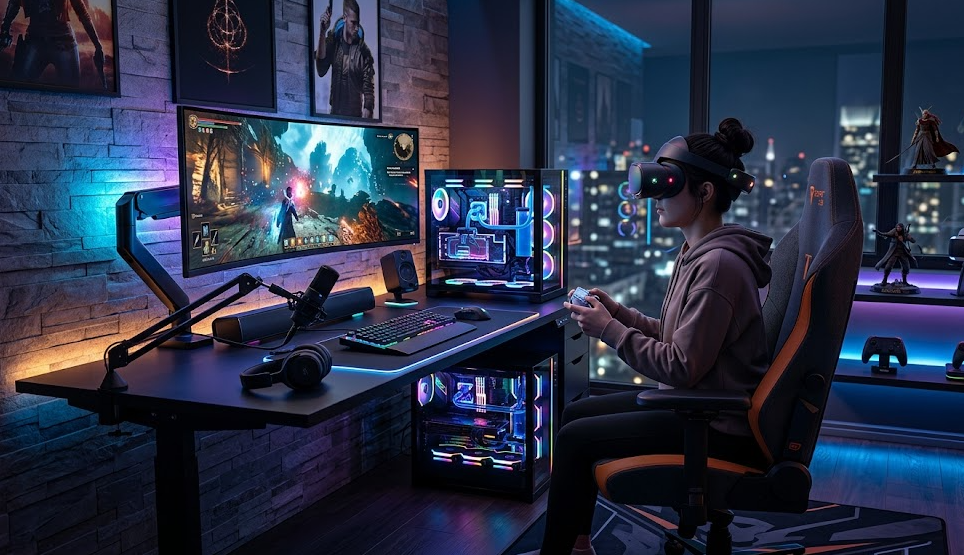
Virtual Reality (VR) and Augmented Reality (AR) are pushing gaming into a fully immersive era. VR headsets like Meta Quest allow players to step inside digital worlds and interact physically with environments.
AR gaming overlays digital elements onto the real world, blending reality with virtual experiences. This technology is widely used in mobile games and educational applications.
With improvements in motion tracking and haptic feedback, VR and AR are becoming more realistic, allowing players to feel physical sensations during gameplay.
High-Performance Hardware Advancements
Gaming hardware has also seen major improvements. Modern CPUs and GPUs are designed specifically for high-performance gaming, delivering faster speeds and better efficiency.
Companies like AMD and NVIDIA continue to release powerful chips that support advanced rendering techniques, ray tracing, and AI processing.
Additionally, high refresh rate monitors (120Hz, 144Hz, and beyond) provide smoother gameplay, especially in competitive esports environments where reaction time is critical.
Modern Game Engines and Development Tools
Game development has become more accessible thanks to advanced engines like Unreal Engine 5 and Unity. These engines allow developers to create highly realistic environments with less effort.
Features such as Nanite and Lumen in Unreal Engine 5 enable cinematic-quality visuals in real time. Developers can also use AI-assisted tools for animation, world building, and physics simulation.
This democratization of tools means even small studios can now produce AAA-level games.
Future of Gaming Technology and Industry Outlook
The future of gaming is expected to be even more immersive and intelligent. Experts predict deeper integration of AI, full VR environments, and completely cloud-based gaming ecosystems.
We may also see brain-computer interfaces and fully adaptive game worlds that respond emotionally to players. what is new in gaming technology jogametech perfectly captures this ongoing evolution toward smarter, more interactive gaming systems.
Gaming is no longer just entertainment—it is becoming a digital lifestyle.
Conclusion
Gaming technology is evolving at an incredible pace, driven by AI, cloud computing, next-gen graphics, and immersive hardware. These innovations are making games more realistic, accessible, and intelligent than ever before. As highlighted in this article, understanding what is new in gaming technology jogametech helps us see how deeply technology is shaping the future of entertainment.
From smarter NPCs to cloud-based gameplay and VR immersion, the gaming world is entering a new era where possibilities are almost limitless.
FAQs
1. What is new in gaming technology jogametech?
It refers to the latest advancements in AI, cloud gaming, VR, and graphics technologies shaping modern gaming.
2. What is the biggest gaming innovation right now?
AI-driven gameplay and cloud gaming are currently the most impactful innovations.
3. Is cloud gaming the future?
Yes, as internet speeds improve, cloud gaming is expected to become mainstream.
4. How is VR changing gaming?
VR creates fully immersive experiences by placing players inside virtual worlds.
